Full Connectivity, Borderless Empowerment - Sungrow Unveils iNexGrid All-Scenario Microgrid Solution at Intersolar Europe 2026
MUNICH, June 26, 2026 /PRNewswire/ -- Sungrow, the globally leading PV inverter and energy storage system provider, released iNexGrid all-scenario microgrid solution at Intersolar Europe 2026. The solution shows an innovative Five-Layer System Protection that delivers superior reliability, full-lifecycle economic benefits and deep decarbonization to high-demand microgrid scenarios including mining, AIDC, commercial & industrial (C&I) and island power supply.

One Core, Multi-Energy & Full Connectivity
Microgrids have become mainstream infrastructure for enhancing energy security and advancing carbon neutrality goal. However, different application scenarios face distinct challenges in reliability and cost-efficiency: Mining microgrids struggle with source-grid-load coordination under high volatility; AIDC microgrids must balance millisecond-level power surges with stringent power quality requirements; C&I microgrids face large loads, peak-to-valley fluctuations, and high demand charges that erode profitability; and off-grid island microgrids remain heavily dependent on diesel generation in harsh and corrosive environments.
"Across different application scenarios, customers are looking for the same core outcomes: stable operation, stronger lifecycle profitability, and intelligent capabilities that support future growth," said Luyao Shi, Product Director of Sungrow Smart Energy. "Built on Sungrow's full-stack in-house technologies, our Five-Layer System Protection is designed to support stable and reliable microgrid operation."
Five-Layer System Protection & Ultimate Stability
Integrating Sungrow's inhouse PV, wind, energy storage, EV charging and cloud platforms, the iNexGrid microgrid adopts PowerTitan 3.0 grid-forming storage and Nexus-M100 microgrid controller to build a full-cycle five-tier protection matrix tailored for different microgrid scenarios.
- Steady State: Proactive Protection
Steady-state proactive protection leverages AI wind-solar and load forecasting to slash power deficits by 80%+, lift prediction accuracy by 10% and shorten project payback by 1-2 years by edge-cloud hybrid and Transformer-GNN algorithms.
- Small Disturbance: Millisecond-Level Local Support
Virtual excitation control, flexible inertia support and fault ride-through technology deliver instant millisecond response, suppressing voltage flicker and minor power fluctuations that pose risks to sensitive AIDC server equipment.
- Large Disturbance: Hundred-Millisecond-Level Coordinated Control
Under the strategy of "Regulation Instead of Shedding", the seamless on/off-grid switching and off-grid secondary frequency and voltage regulation technology can sustain key loads such as mine ventilation and AIDC data storage facilities.
- Major Fault: Second-Level Emergency Control
Coordinated multi-voltage-source control between diesel and ESS paired with automatic fault disconnection, the system can have second-level emergency control when facing Major Fault.
- Grid Fault Collapse: Minute-Level Grid Self-Healing
Even amid grid fault collapse, the large-scale black start technology enables GW-scale plant to restore full microgrid power supply within 1 minute.
Customized Solutions for N+ Core Scenarios
Built on the iNexGrid Five-Layer System Protection, Sungrow delivers tailored solutions for diverse microgrid scenarios.
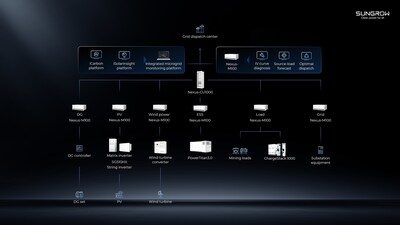
- For mining microgrids, the "Regulation Instead of Shedding" strategy enables the Nexus-M100 controller to dynamically adjust storage and diesel output, lifting power reliability to 99.99% and preventing costly production shutdowns.
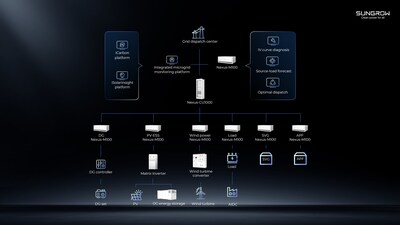
- For AIDC microgrids, frequency-decomposed power control combined with grid-forming storage effectively smooths power swings, limiting voltage and frequency deviations within ±2% to prevent server downtime and data loss.
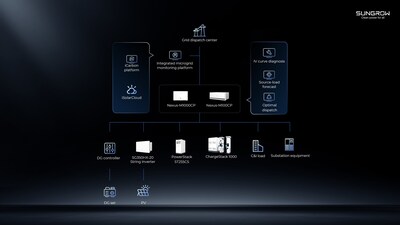
- For C&I microgrids, AI-driven Optimal Dispatch helps reduce peak electricity fees to raise comprehensive returns by 12%, while a hierarchical collaborative architecture enables millisecond-level joint control across all assets.
Proven Global Track Record & Streamlined Delivery Capacity
Sungrow has delivered microgrid projects globally, including those for Naipu Mining Machinery in Zambia and the HyIron Oshivela project in Namibia. This success is supported by the company's total installed capacity exceeding 1,000 GW worldwide.
Besides, iSolarDesign improves design efficiency by over 99% via 8,760-hour full-sequence simulation and optimization covering 10,000+ scenarios. GW-scale simulation effectively enhances system stability, while prefabricated delivery shortens installation and enables operation up to 17 days earlier. The iCarbon platform supports smart carbon management, driving efficient full-chain carbon accounting across microgrids and predictive O&M to enhance full-cycle system performance.
"The name iNexGrid embodies our vision: future microgrids will no longer be isolated systems tailored for a single scenario, but universal, intelligent, and continuously evolving smart microgrid hubs," Luyao Shi concluded. "Sungrow will continue to deepen the integration of AI technologies with microgrids, making microgrid solutions more intelligent, scalable, and easier to deploy, while contributing to the global energy transition."

Photo - https://mma.prnewswire.com/media/3000914/image1.jpg
Photo - https://mma.prnewswire.com/media/3000911/image2.jpg
Photo - https://mma.prnewswire.com/media/3000913/image3.jpg
Photo - https://mma.prnewswire.com/media/3000912/image4.jpg
Logo - https://mma.prnewswire.com/media/1344575/Logo.jpg
 View original content:https://www.prnewswire.co.uk/news-releases/full-connectivity-borderless-empowerment---sungrow-unveils-inexgrid-all-scenario-microgrid-solution-at-intersolar-europe-2026-302811478.html