Hyundai Motor Group Accelerates Autonomous Driving Innovation with AI-Powered Data Flywheel
- Hyundai Motor Group hosts "HMG Autonomous Driving Media Day", outlining its roadmap for the next era of autonomous driving; first showcase of Level 2++ technology
- Dual-Track strategy accelerates Level 2+ production through NVIDIA collaboration while internalizing key autonomous driving technologies through proprietary Atria AI
...NVIDIA solutions-based Level 2+ production targeted for the H1 2028 and Level 2++ in H2 2028, followed by Atria AI-powered Level 2++ vehicles in H2 2029
...Progressive sensor standardization across Hyundai Motor, Kia, 42dot and Motional brings together autonomous driving capabilities across the Group - Data Flywheel strategy establishes a virtuous cycle of data collection, training, validation and deployment to continuously advance AI capabilities
...Expands the Group's data ecosystem by leveraging its annual sales of 7 million vehicles and Data Union framework, while implementing a data-centric development framework based on hard example mining, continuous training and SER
...Real-world Level 4 pilot to launch in Gwangju by year-end in partnership with Korea's Ministry of Land, Infrastructure and Transport to secure large-scale validation data - 42dot shares Vision-Language-Action (VLA)-based autonomous driving technology that integrates visual information and language-based reasoning to guide driving decisions
...VLA research focuses on addressing edge cases, while parallel development of end-to-end (E2E) autonomy and VLA models enhances technical stability and scalability
...VLA model validation currently underway, with on-road testing and the full development process scheduled to run through early next year - New Atria AI urban driving videos — an executive ride-along, one-take footage, and edge-case handling — are live on the Group's YouTube channel
SEOUL, South Korea, Sept. 13, 2026 /PRNewswire/ -- Hyundai Motor Group (the Group) announced that it has put its Data Flywheel into full operation, marking a new phase in its autonomous driving technology strategy. The system creates a virtuous cycle of data collection, AI training, validation and deployment to secure a competitive advantage through accelerated learning and technology development.
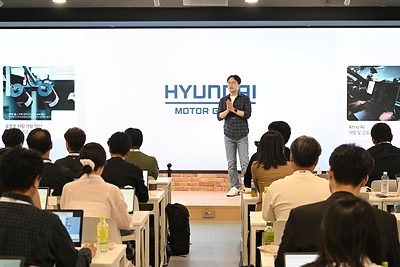
During the Group's "HMG Autonomous Driving Media Day" at 42dot headquarters in Gyeonggi Province, Korea, the Group presented its autonomous driving development strategy, technology roadmap, key achievements and implementation plans. The presentation underscored the Group's strategic positioning in the global autonomous driving technology competition and detailed how integrated data and AI systems form the foundation for next-generation vehicle technology.
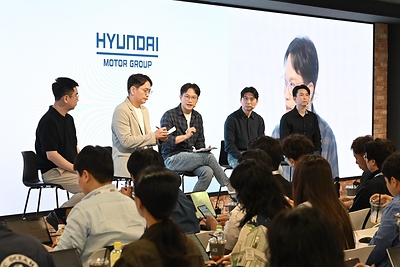
At the event, the Group identified the Data Flywheel as a key element of its autonomous driving competitiveness and shared the operational framework and execution strategy that transforms large-scale real-world driving data into continuous technology improvements.
42dot also introduced key technologies and the development progress for the Group's proprietary autonomous driving artificial intelligence, Atria AI, while outlining the background and future plans for its Vision-Language-Action (VLA) technology development initiative.
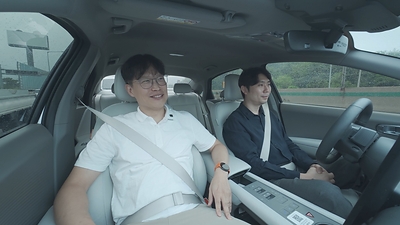
In line with the event, the Group unveiled footage of an Atria AI-equipped SDV Testbed navigating complex urban traffic without driver intervention. Operating at a Level 2++ capability, the autonomous driving system showcased in the footage illustrates how the Data Flywheel is enabling a continuous cycle of learning, validation and performance improvement. The footage is available on the Group's official YouTube channel.
"Autonomous driving competition is no longer about comparing specific features. Competitiveness is determined by how much data you secure, how quickly you learn and how effectively you can reflect those results in actual products and services. At its core, autonomous driving competitiveness comes down to having systems that enable continuous, rapid learning. Hyundai Motor Group will develop autonomous driving technology that customers can trust, based on a virtuous cycle of data, AI and validation. Our goal is to ensure the safety and quality levels customers can trust while we learn and improve rapidly." – Minwoo Park, President and Head of Advanced Vehicle Platform (AVP) Division at Hyundai Motor Group and CEO of 42dot
About Hyundai Motor Group
More information about Hyundai Motor Group can be found at: http://www.hyundaimotorgroup.com or Newsroom: Media Hub by Hyundai, Kia Global Newsroom, Genesis Newsroom
 View original content to download multimedia:https://www.prnewswire.co.uk/news-releases/hyundai-motor-group-accelerates-autonomous-driving-innovation-with-ai-powered-data-flywheel-302876372.html