The 28th China Beijing International High-Tech Expo Opens
BEIJING, May 8, 2026 /PRNewswire/ -- This is a news report from CCTV.com:
The 28th China Beijing International High-Tech Expo (hereinafter referred to as CHITEC) is held at the China National Convention Center in Beijing from May 8 to 10. With the theme of "Technology Drives Progress, Innovation Shapes the Future", the event covers an exhibition area of approximately 50,000 square meters, attracting over 800 Chinese and foreign enterprises and institutions as exhibitors.
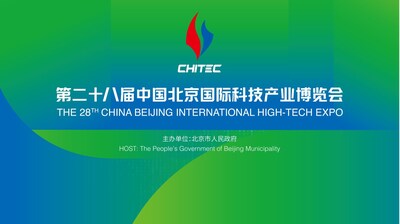
The 28th CHITEC features three major segments: exhibition display, trade and investment promotion, and online exhibition & matchmaking. The exhibition features six specialized exhibition zones: Information Technology, Healthcare, Green and Low-Carbon Development, Intelligent Manufacturing, Digital Economy, and Regional Innovation. More than 20 trade and investment promotion events and five parallel activities including the China-EU Carbon Neutrality Practice Matching Conference will be held. The upgraded online platform builds a 365-day "never-ending" space to bolster international sci-tech cooperation.
The 28th CHITEC boasts four major highlights.
Cutting-edge Strength & Frontier Leadership: Focusing on global sci-tech frontiers, the Expo gathers top research institutes, industry-leading enterprises and innovative organizations, showcasing world-first and independently controllable key core technologies.
Capital Advantages & Collaborative Innovation: Leveraging Beijing's resource strengths, the event fully demonstrates the innovation source capacity of the "Three Science Cities and One Demonstration Area". Delegations from Tianjin and Hebei showcase abundant featured achievements, advancing in-depth integration of industrial, innovation and supply chains across the Beijing-Tianjin-Hebei region.
Two-way Cooperation & Interconnection: Multinational enterprises including Sweden's Envac Group, AstraZeneca and Sanofi attend the Expo Events such as the Beijing-ASEAN Sci-Tech Industry Promotion and Business Matching Conference and the 2026 Beijing Green Innovative Technology Exchange Meeting are held to introduce high-quality global sci-tech resources.
Sci-tech for People's Wellbeing & Consumption Stimulation: Multiple autonomous driving models such as L4-level RoboBus, UAV simulated flight system, 4D Gaussian Splatting dynamic real-scene reconstruction system and Huaxia Bailing AI Smart Headphones are on display. Immersive programs are arranged in the popular science exhibition area. Beijing North Star Group collaborates with commercial districts to launch public welfare activities, advancing the integrated development of "exhibition + cultural tourism + commerce".
Centering on achievement exhibition, collaborative innovation, open cooperation and public benefit sharing, the 28th CHITEC fuels the high-quality development of Beijing, coordinated innovation of the Beijing-Tianjin-Hebei region, and global sci-tech exchanges and cooperation.
Photo - https://mma.prnewswire.com/media/2975853/image1.jpg
 View original content:https://www.prnewswire.co.uk/news-releases/the-28th-china-beijing-international-high-tech-expo-opens-302767150.html